Contact support

Compare opening-range break paths

Use the opening-range comparison to see how often price closed back inside within 30 minutes of the first break. The first break above and the first break below form separate groups.
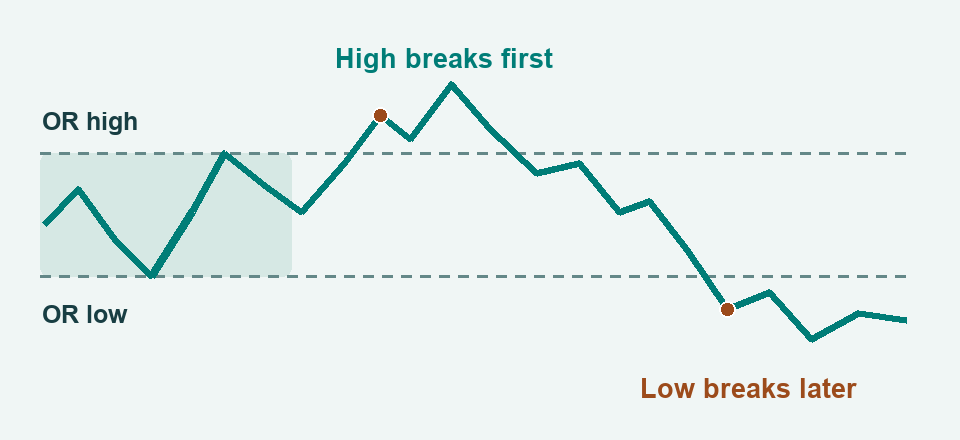
Identify the first break

  1. Find the five-minute opening range. For CL, ES and NQ it begins at the regular session open. For FDAX, FESX and FGBL it begins one hour after the regular session open.
  2. After the range ends, identify the first minute that trades above its high or below its low. If the same minute crosses both boundaries, the first direction is ambiguous.
  3. For a confirmed return, a later minute must close inside or on the boundary without a new break through either boundary in that minute. Count up to 30 elapsed minutes between minute closes, subject to the verified session close.
Illustrated session breaks above the opening range first and below it later.
A later break below the range leaves this session in the first-break-above group.

Read each direction separately

A first break at 09:38 followed by a confirmed return at 10:08 meets the 30-minute cutoff. A later break on the other side leaves the first direction unchanged. Read incomplete follow-up and ambiguous first breaks alongside the two return rates.

To study excursion distance, use the Statistics Library distributions for the first upward break, second upward break, first downward break or second downward break.