Contact support

Read the return rate in the ES early-break example

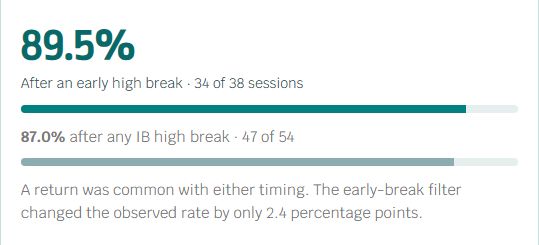
In the dated ES example, 34 of 38 early breaks above the initial balance high returned inside the range within the observation window. That gives the displayed 89.5%.
Reconstruct the two clocks

  1. Use the ES sample from 6 July through 2 November 2026. The initial balance is the first hour of the regular session in New York time. Mark its high after that hour ends.
  2. Count a session in the early-break group if price breaks above that high within the next hour. There were 38 qualifying sessions.
  3. Start a new clock at the break. Look for a return inside the initial balance within one hour, stopping at the regular close if it comes sooner.
ES early-break and broader-break samples with their return counts.
Read each return count against its own eligible sessions.

Compare the two samples

The early-break group had 34 returns in 38 sessions. Four had no observed return by the cutoff. The broader group, which allowed an IB high break later in the session, had 47 returns in 54 sessions (87.0%). It includes the early breaks.

The 2.5 percentage-point difference describes these overlapping samples. The result counts a return inside the range. Estimating what a trade would have earned also requires an entry, an exit and costs.